
Voices In My Head
Updated: Jan 18
A short history of magic in and on the air

Even though I am clearly part of the first television generation—and dutifully put in my 17,000+ hours of viewing before I moved out of my parent’s house—radio has a special place in my heart. There’s something about a disembodied voice floating in the space between one’s ears that holds a special power.
It began when I could barely walk. My mother kept the radio on most days, rather than the TV. Maybe it was so that she could go about her chores with some adult companionship. Regardless, that big heirloom box in the corner of the living room, with the pilled fabric face and the heavy wooden lid, concealing a mass of glowing tubes and illuminated dials, was a fixture of my early days. And plenty mysterious—that mahogany cabinet was as tall as I was, an twice as loud. But the music, and the voices, filled my little world. I remember “Godspeed, John Glenn”, “Hi-Ho, Hi-ho, It’s off to work we go” and perhaps most urgently, that “Chock Full O’ Nuts is a heavenly coffee…”
And so radio became important. Later, when Grandma’s ancient tuner was traded in for a small shiny plastic box, the sounds moved into the kitchen, and continued as part of our morning routine. Over breakfasts of Post Corn Flakes and Strawberries, we listened to “Rambling with (John) Gambling” a fixture on WOR. His relentless jovial banter closed the gap between our little town and the great metropolis across the Hudson river.
Traffic reports from helicopter pilot “Fearless Fred Feldman” gave the morning scope—even if I wasn’t exactly sure what “rubberneckers” and “the Bruckner Expressway” were. But we would march out of the house to Gambling’s theme song, “Pack up your troubles (in your old kit bag)” and as Mitch Miller’s men’s chorus instructed, we would smile, smile, smile.
And so it came to pass a few years later that my brother Steve and I were gifted that old radio for our bedroom. On the recommendation of our old man, we drifted off to sleep listening to a late-night broadcast. It began with the trumpet call of a horse race, hardly a lullaby! And as the galumphing theme song played, a wry, almost conspiratorial voice began to talk to us through the transistors. This was the voice of a man who had seen much and did not suffer fools gladly–he admonished that “In God We Trust, All Others Pay Cash”—but he welcomed us too, a couple of kids still wet behind the ears.
In fact, he would often tell stories of his own childhood, growing up in suburban Indiana during the depression. And remarkably, even though his reference points were steaming cups of Ovaltine, Little Orphan Annie comic strips, and Fibber McGee’s closet, we could relate. Jean Shepherd, who is now best remembered for writing and narrating A Christmas Story was also a fixture on WOR for twenty years, neatly overlapping my first two decades. I listened to “Shep” as often as I could, and began to absorb his progressive, humanist sensibilities as well. Best of all, he didn’t preach, but was a keen observer of the human condition. That suited my own sensibilities.
As I got older, and stayed up too late to hear Shep, I found a different sort of companion in “The Nightbird” on WNEW. Driving home from college after putting the school newspaper to bed, I would let myself enjoy the seductive sound of Alison Steele, a rare female voice on the fledgling FM rock scene. A little poetry, a little mysticism, a deep cut from a Todd Rundgren album… I got to imagine what a perfect girlfriend might look like. “Come fly with me until dawn,” she would purr. Ahh, if only.
Moving to California, it was awhile until I latched onto any suitable replacement for my old friends. Radio continued to be a constant, if less satisfying companion, especially as I labored thru years on the swing and graveyard shifts, traversing the Bay Area on dark and lonely delivery routes. Listening in those days was a matter of opportunity. What was on when you could listen? I was sleeping during prime time and listening during the doldrums, so pickin’s were slim.
It wasn’t until I got a proper day job with a morning commute that I found Alex Bennett on “Live105”—and he brought a bucket of new acquaintances. More of a wise-guy ringleader than singular voice, Bennett corralled a large stable of local and national stand up comics, and we were introduced to the next generation of talent (Dana Carvey, Bobcat Goldthwaite, Kevin Pollock, Paula Poundstone, to name a few) that would make their mark in subsequent decades. They gave me a few laughs when I most needed it—and left me feeling like I had friends in show business.
It was also thru work that I made a lifelong connection. A miserable two-week stint at SF General, working as a graphic designer in the research dept., has been largely forgotten except for two things: First, the indelible experience of sitting in a stifling, windowless room drawing diagrams of cell structure while breathing yeasty vapors from a row of petri dishes along the wall. And second, discovering the nerdy, nasal voices of Susan Stamberg and Terri Gross on NPR, who filled my head with opinions, ideas, and a new auditory baseline. (Although to this day, I can still catch a whiff of sour, moldy bread at the sound of the Morning Edition theme song…)
There are others who have come and gone, voices that I came to rely on for a smile, for stimulation, or just simple companionship. I miss the dulcet voice of Keith Lockhart weaving in and out of KKHI’s morning classical playlist. I could always count on Harry Shearer on Le Show to make fun, if not make sense, of what’s happening in the world. As opposed to Anne Strainchamps of the late and lamented To The Best Of Our Knowledge, who simply and directly asked experts and artists deep questions about deeper subjects (like “what is time?”)—that would linger long after the radio went silent.
Listening so intently for so long has certainly reset my energetic vibrations. So much and so deeply that I regularly, literally, dream of being a radio disc jockey. Not so much to cue up platters of music for listeners, but to have a platform to reach into other people’s consciousness—and connect. To discuss the issues of the day, To share innermost thoughts without fear of consequence, and make friendships that would last forever.
I have made one, for sure.
When I landed my first “real job”—one that actually employed my skills and engaged my creativity—the world grew exponentially. I became comfortable enough to reveal my taste in music, especially movie soundtracks, and would unashamedly play a couple of film scores in the art dept. boom box rotation. One of my colleagues heard a particularly boisterous cue from The 7th Voyage of Sinbad and remarked, “Hey, that sounds like what Robert plays on Saturdays. Do you listen to him?”
At first, it didn’t compute. Who was Robert and why was he secretly playing my cassettes when I was not in the office? No, Tita explained, he was a disc jockey on a local college station, and he played soundtrack music for three hours every weekend. “You should check it out.”
In my car on the way home, I tuned into the lower end of the dial, and was dismayed to find a station broadcasting music that, politely, sounded as though someone had left a phone off the hook in a high school metal shop. A typically sarcastic DJ explained what we were listening to and promised more to come. But not for me—the signal grew fainter and more filled with static every mile I traveled. At home I stretched and twisted the stereo antennae wires like a mad semaphore, to no avail. The mystery was unresolved.
Eventually, I found myself at work on a weekend and managed to tune into The Norman Bates Memorial Soundtrack Show for the first time. The validation of hearing my favorite music ON THE RADIO was overwhelming. No one else was playing Bernard Herrmann (Psycho!), Jerry Goldsmith (Chinatown!!) or, god bless him, Hoyt Curtin (The Flintstones!!!), much less name-checking these relatively obscure composers at all. Add to that playing comedy sketches by Bob and Ray, a cold-war PSA by Groucho Marx and the Supremes singing “Downtown” in Deutsch. Who is this guy?
At first I didn’t know much—his voice was sonorous and relaxed, with a dollop of mid-western nice. He had catholic tastes for sure, introducing his show over a melancholy accordion theme as home to “soundtracks, show tunes, television themes… all the music that you’ve come to trust over the course of several generations.” He was clearly of my generation, with an ear (and eye) for pop culture at large. Sometimes he would play something I loved but didn’t recognize, which led me to call the station. He’d pick up, and helpfully explain where I might find said recording before returning the show. I was sure I’d heard him smiling.
Beyond the shared interests, however, I could detect a shared sensibility. The host was clearly proud to be a resident of the Bay Area, promoting cultural and community events every week. He features a regular segment called “Cool Secret Places,” introducing singular attractions, businesses and institutions deserving of our attention, “because they make where we live so special.” And he encourages listeners to turn off the radio and “get out and do stuff”—he does a lot himself, showing up for station events, supporting other DJs, encouraging newbies, and producing some of the cleverest on-air promos on a station that’s full of them.
For almost a decade I listened when and where I could, eventually moving into a more receptive part of the Bay Area, where radio signals were not impeded by hills and valleys. And I circumnavigated another impediment—once too shy to strike up a conversation, I had graduated into working in the soundtrack biz and could talk to Robert as a peer. Not that it was ever necessary—we had a LOT in common, soon recognizing each other as a “brother from another mother.” In a short time, we became friends, and by donating to the station’s annual fundraiser, I could join him on the air as well.
This weekend marks my 17th appearance on 89.7FM, and this week’s theme for the show is a tribute to Frankenstein. I have twenty or thirty possible songs to cue up, but darned if Robert hasn’t managed to find twice as many forgotten pop songs, movie trailers and other bits of audio ephemera to add to the mix. Whatever gets played, we will both have more to say about each and every golden nugget than 180 minutes could contain. I expect we’ll both wear our signature KFJC bowling shirts (which Rob invited me to design for a previous fundraiser), finish each other’s sentences and generally have a blast.
Unlike a podcast, which can be a little too scripted (or a little too anarchic), I think the rigor of a live radio show strikes a nice balance. You’ve gotta stay sharp and remember there’s an audience out there, who will be calling in to identify the “Mystery Television Theme of the Week,” among other things. I hope that you can join us live on Saturday January 17th, from 9:00am to noon PST, or else visit the station Archives, where you can download or stream the show for the next two weeks. If you missed it, check out another example on my website here.
When I was growing up, I would have loved to be a disc jockey, but now I’m just grateful to call one a friend. Thanks Robert!
***
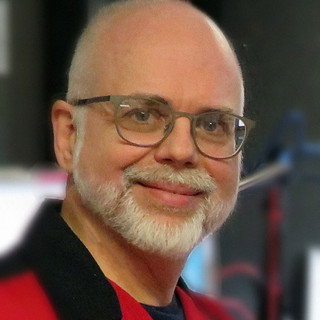
Robert Emmett McGlynn has hosted Thoughtline as well as The Norman Bates Memorial Soundtrack Show on KFJC for more years than he cares to count, also acting as station manager for a time, and was recently a nominee for the Bay Area Radio Hall of Fame. I can’t imagine the airwaves without him.


Nice collection ‘o memories you’ve written here. I resemble a lot of your remarks and had the joy of being a guest DJ on the NBMS show just last Saturday. Boy, was that a great time with a great host.
Rena
Fantastic, Joe. Such a wondrous and nostalgic journey with a promise of the now. Break Legs!